


Principles of bioimpedance analysis (BIA)
Bioimpedance analysis (BIA) has been used to determine body composition since the 1970s. It involves passing a low-intensity alternating electrical current through the body and measuring the resistance of tissues to the current. The impedance, phase angle, resistance and reactance values collected by the measuring device enable the body compartments crossed by the current to be determined through algorithms, providing — depending on the type of device — a more or less precise and detailed result of body composition. The current used is of very low intensity and is completely painless.
Learn more about the professional bioimpedance analyser

Electrodes in direct measurement
The eBIODY devices feature a direct measurement patented by AMINOGRAM. This measurement avoids potential interference between electrodes and provides a direct hand/foot connection.
Here are the differences between direct and indirect measurement devices.
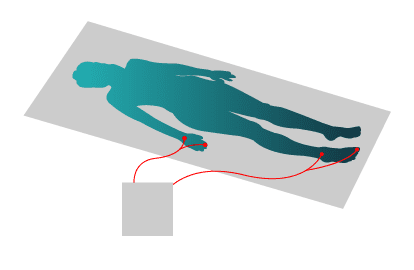
Indirect measurement
- Measurement that can be carried out on all patients regardless of their condition
- Constant electrode change (1 measurement = 1 electrode), consumables cost
- Long and meticulous procedure for electrode application on the patient

Direct measurement
- Easy electrode positioning
- Fast measurement
- No consumables
- Seated and lying measurement
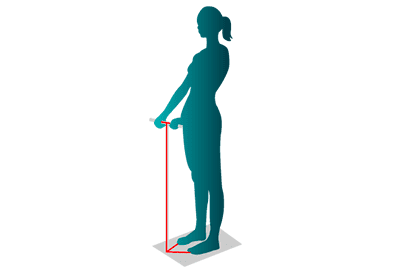
Indirect measurement
- Easy electrode positioning
- Fast measurement
- No consumables
- With articulated arms, potential variation in results depending on measurement angle.
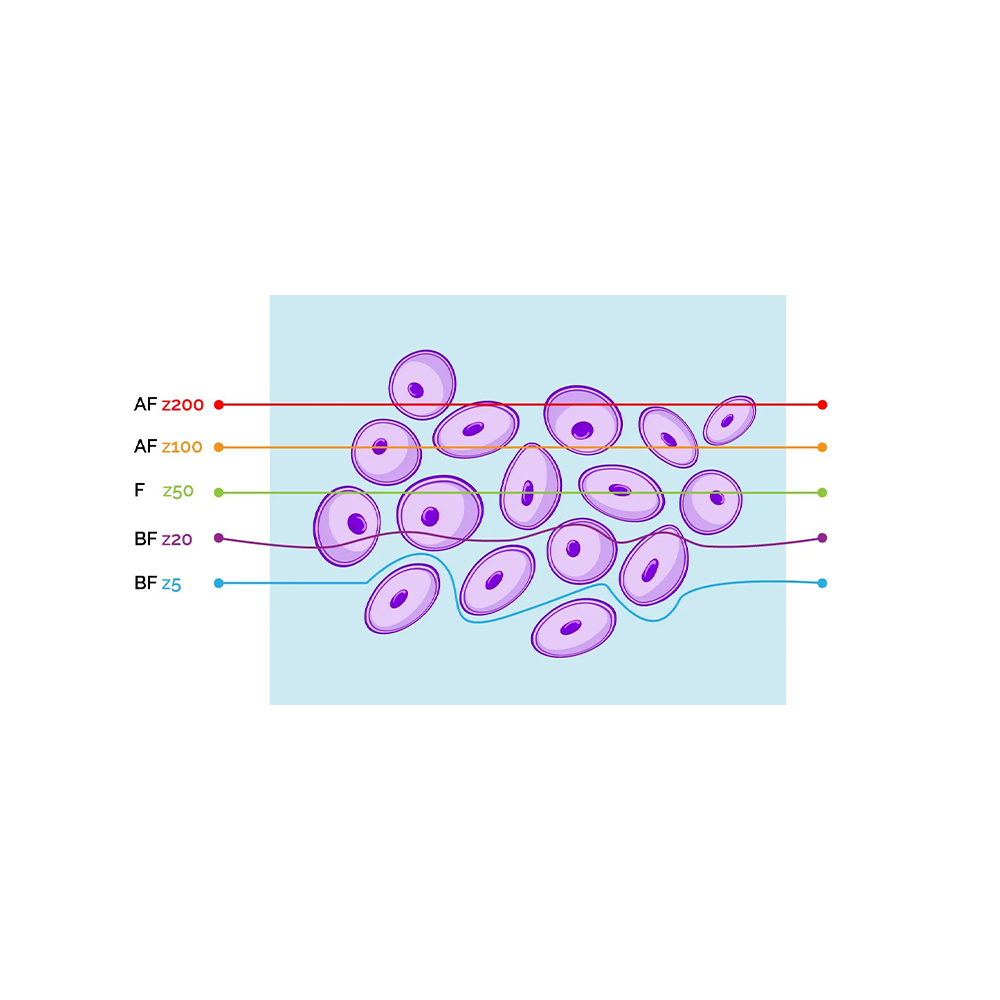
Multi-frequency technology
Electrical currents have different penetration capabilities depending on their frequency. Multi-frequency therefore enables more impedances to be measured, bringing greater reliability and precision to the results obtained.
The eBIODY devices use 5 frequencies: 5, 20, 50, 100, 200 kHz
Body compartments
Multi-frequency devices enable analysis of body compartments. Up to 7 compartments can be analysed.
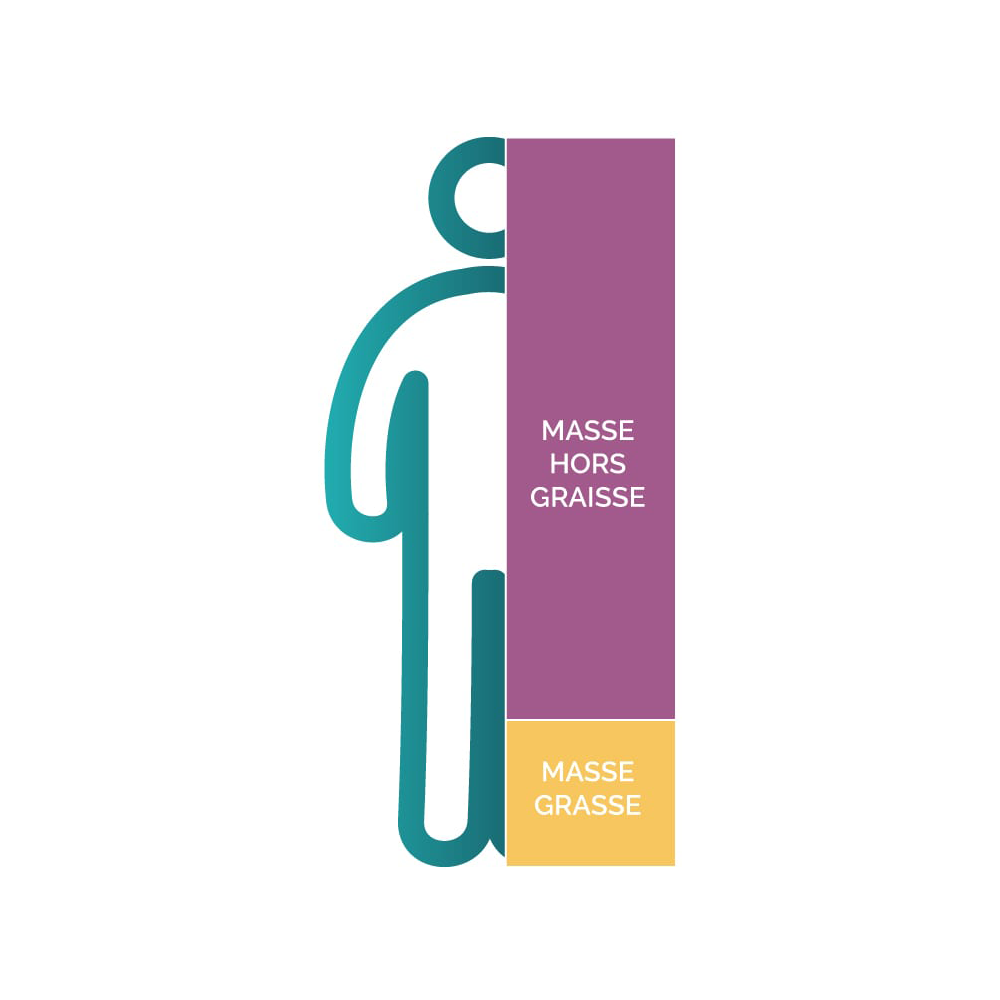
Compartments analysed with Mono-frequency
- 1 frequency at 50 kHz
- Measures total water
- 1 to 3 compartments: water fluctuations in the individual systematically cause variations in fat mass and muscle mass.
- Limited analysis
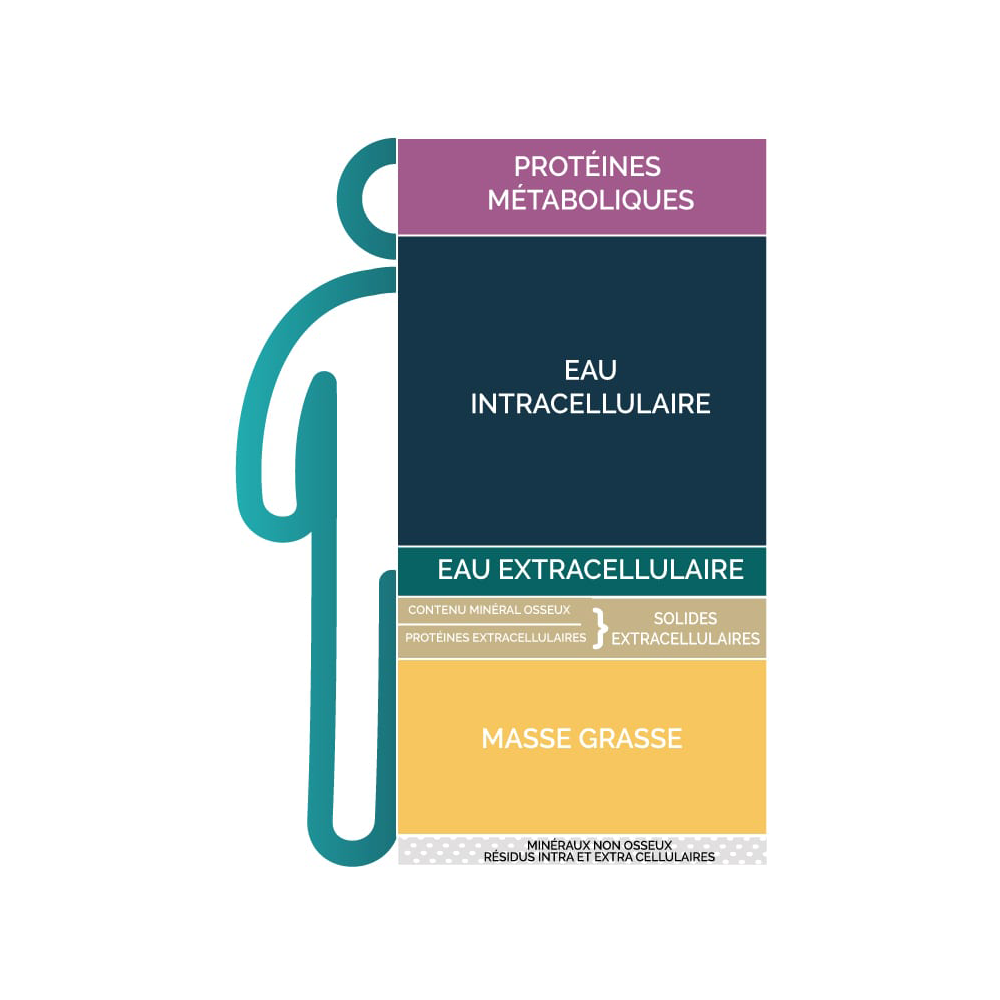
Compartments analysed with Multi-frequency
- Multiple frequencies
- Differentiates intra- and extracellular water
- Multi-algorithm
- Complete analysis
Two methods in bioimpedance analysis Multi-Algorithm Method
The two most common methods in bioimpedance analysis are the deductive mono-algorithm approach, which is based on the following postulate: 'Regardless of the individual (gender or age), their hydration is constant (for example at 73.3% of their fat-free mass) and the other compartments are defined only by coefficients based on constants. This method uses a single algorithm for water.'
The other method, the multi-algorithm approach, includes essential algorithms such as an algorithm for fat-free mass and an algorithm for total water, enabling the actual hydration rate of fat-free mass to be obtained and thus to detect whether the person is well-hydrated, overhydrated or underhydrated.

Mono-Algorithm
- Calculates only water
- Other compartments are estimated relative to water quantity using multiplier coefficients
- Cascade effect if the person is over- or underhydrated
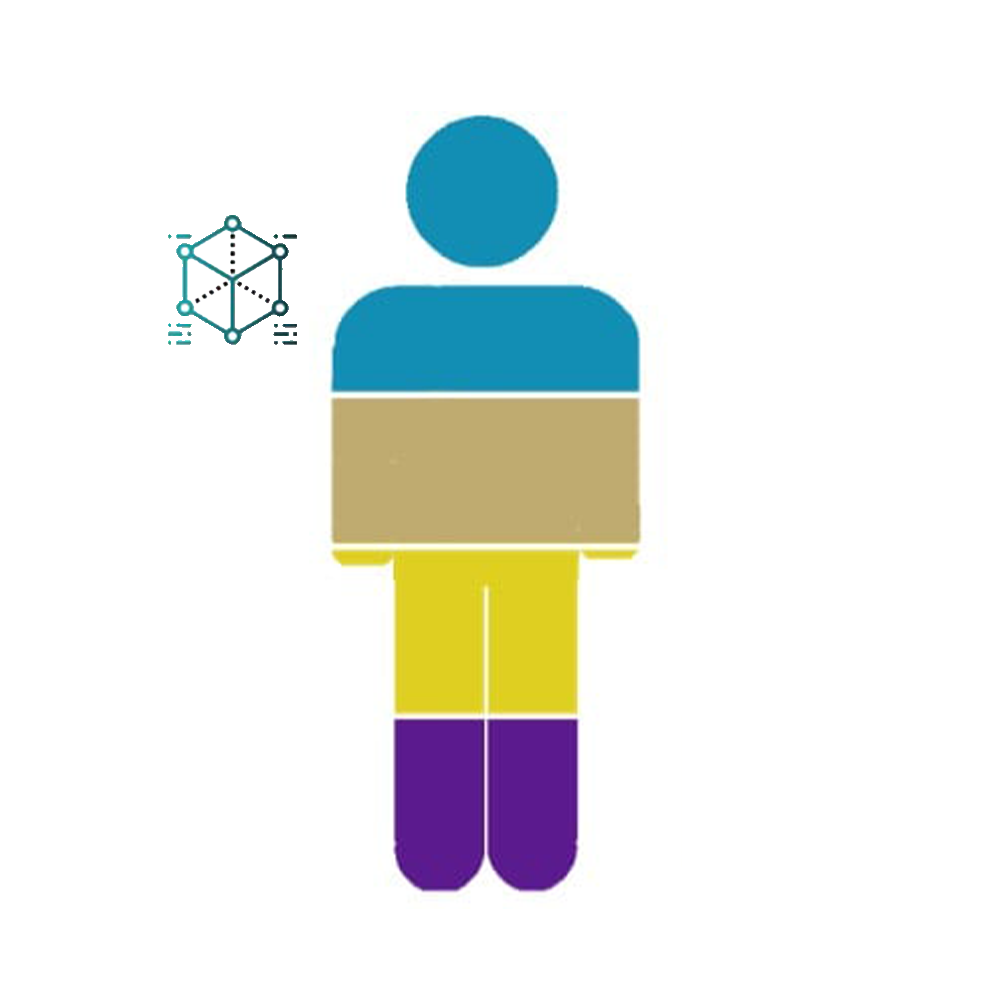
Compartments analysed with Multi-frequency
- Calculates the 5 'Key' compartments (TBW, ECW, DFFM, CMO, ASMM)
- Provides access to all compartments
- Provides a precise hydration rate